
“I still believe nicotine patch + caffeine is one of the all-time greatest stimulant combos.”
— Alex Hormozi, @AlexHormozi, April 9, 2023
When someone with millions of followers and a nine-figure business portfolio says something is his cognitive secret weapon, people pay attention. Hormozi’s tweet sent thousands of people searching for more. Is it real? Is it safe? And — the question almost nobody asks — is he doing it correctly?
We’re an evidence-based research site. So we ran the claim through the literature.
The conclusion: The synergy is real. The way most people execute the stack is not.
Why These Two Together?
Caffeine and nicotine work through completely different brain systems — which is exactly why combining them makes mechanistic sense. They’re not doubling down on the same pathway; they’re addressing different cognitive limiting factors simultaneously.
For a full breakdown of how each compound works independently, Nicotine vs. Caffeine for Focus covers the mechanisms in detail. The short version:
- Caffeine blocks adenosine receptors, clearing the fatigue signal that accumulates throughout the day
- Nicotine activates nicotinic acetylcholine receptors, directly sharpening attention, working memory, and signal processing
Caffeine reduces cognitive noise. Nicotine improves cognitive signal. Together, the theory goes, you get less interference and better transmission.
What the Research Actually Says About the Combination
This isn’t just bro-science. There’s peer-reviewed literature on the combination specifically.
A study published in Metabolic Brain Disease examined caffeine and nicotine separately and combined, measuring working memory, motor function, and neurochemical markers. The finding: the combination improved non-spatial working memory, motor coordination, and spatial memory beyond what either compound achieved alone. The interaction was described as additive to synergistic depending on the specific outcome measured.
A separate study published in PMC examined dopamine release in reward-related brain circuits. The caffeine and nicotine combination produced dopaminergic effects more pronounced than either substance in isolation — a result the researchers described as “more complex than a simple sum” of individual effects, suggesting a genuine pharmacological interaction rather than simple addition.
The two-line scientific summary: caffeine clears adenosine interference. Nicotine activates the acetylcholine attention pathway in that cleared space. The research supports the concept. The problems are entirely in the execution.
The Part Hormozi Got Right
Even setting aside the dose question (which we’ll get to), Hormozi’s timing intuition shows real pharmacological understanding.
His November 2023 productivity post listed caffeine “every other day” — this is tolerance management. Chronic daily caffeine upregulates adenosine receptors, requiring progressively more caffeine for the same effect. Cycling prevents this.
Nicotine in the afternoon also makes pharmacological sense. Nicotine doesn’t block adenosine, so afternoon use doesn’t disrupt sleep architecture the way afternoon caffeine does. It metabolizes relatively quickly, and its mechanism is distinct enough from sleep regulation that it can be used later without the sleep penalty caffeine carries.
Morning caffeine for broad activation, afternoon nicotine for precise execution — the timing logic maps onto how both compounds’ mechanisms and half-lives actually work. Credit where it’s due.
The Part That Undermines the Whole Stack
Here’s where the popular version of this stack falls apart.
Hormozi specifies a nicotine patch. Standard OTC nicotine patches deliver 7mg to 21mg of nicotine over 16–24 hours. The peer-reviewed research on nicotine’s cognitive benefits consistently identifies 1–2mg as the optimal dose range — well below even the lightest commercial patch.
This isn’t a small variance. A 7mg patch delivers three to four times the research-optimal dose. A 21mg patch delivers ten times that amount.
What happens above 2mg? The cognitive benefits plateau and then reverse. High-dose nicotine becomes anxiogenic — it raises anxiety levels, which directly opposes focused cognitive work. Combined with caffeine’s already-stimulating effect on heart rate and blood pressure, the cardiovascular load at patch doses is substantial.
For a detailed look at how this dose problem plays out across the most popular nicotine products, see the ZYN review — the math is similarly unfavorable for standard 6mg pouches.
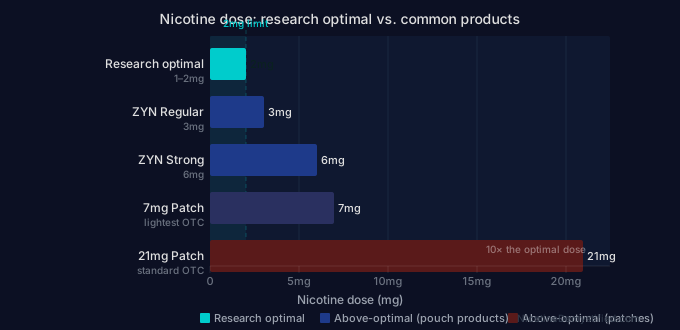
The biohacker community adopted the concept without doing the dose-response reading. At patch doses, you’re not running the stack the research describes. You’re running a much higher-dose stimulant combination that tilts toward overstimulation — more jitters and anxiety, less of the precise attention improvement the mechanism promises.
What a Research-Calibrated Version Looks Like
If you want to approximate what the literature actually supports:
- Caffeine: 100–200mg (one to two cups of coffee), cycled rather than used daily to preserve sensitivity
- Nicotine: 1–2mg, via a delivery method with moderate absorption speed — not a patch, and not a 6mg pouch
- Timing: Caffeine earlier in the day, nicotine later when adenosine has built up and you need precision without the sleep penalty of another caffeine dose
- Frequency: Intermittent, not daily — especially on the nicotine side
Finding a genuine 1–2mg nicotine product is harder than it should be. The market gap between what the research supports and what’s commercially available is the core problem we document on this site. The full picture is in Nicotine for Focus: What the Research Actually Shows.
The Risks You Need to Understand
Addiction: Both compounds are addictive. Nicotine dependence can develop with consistent daily use. The dopaminergic effects that contribute to focus are the same mechanism that drives dependence. This is pharmacologically inevitable for a meaningful subset of users.
Cardiovascular load: Caffeine raises blood pressure and heart rate. Nicotine does the same. Their combined effect is at minimum additive. For anyone with cardiovascular risk factors, this combination warrants a real conversation with a healthcare provider before use.
Escalation: Nicotine tolerance dynamics are well-established. Users who start at low doses frequently find themselves at higher doses within months, chasing the same effect. This is worth monitoring actively.
The Bottom Line
Alex Hormozi isn’t wrong that caffeine and nicotine have a synergistic relationship with documented cognitive effects. The mechanism is real, the research supports the concept, and the timing logic he describes maps onto the pharmacology reasonably well.
Where the conversation needs upgrading: dose matters enormously. The doses most people actually use — patches and 6mg+ pouches — are well above what the cognitive research supports. Applying “more is more” thinking to a compound where the research identifies 1–2mg as the sweet spot produces a worse outcome than the low-dose version of the same stack.
The concept Hormozi is describing is worth taking seriously. The execution most of his followers will default to is not.
→ Want to know where you stand on the nicotine research? Take our 4-question quiz — we’ll show you what the evidence says about your specific situation.
Nicotine is addictive. This content is for educational purposes only and is intended for adults 21 and older. Nothing here constitutes medical advice. Consult a qualified healthcare provider before making any decisions about nicotine use.